Insurance Rates Are Cooling in 2026. Here's Why You Still Need an Independent Insurance Agent in Utah

July 14, 2026

By Jett Iverson, Director of Marketing | The Insurance Center

Published: July 2026 | Farr West, UT serving Northern Utah and beyond

Your renewal notice showed up, and the number went up again. Maybe not as much as last year, but it went up. If you've been hearing that the insurance market is finally stabilizing in 2026, that headline probably didn't match what you saw on your own bill. Here's the short answer: market-wide stabilization doesn't mean every carrier treats you the same way, and the only way to know if you're actually getting a fair deal is to have someone shop it for you. That's what an independent insurance agent in Utah does that a single carrier's website or a captive agent never will.

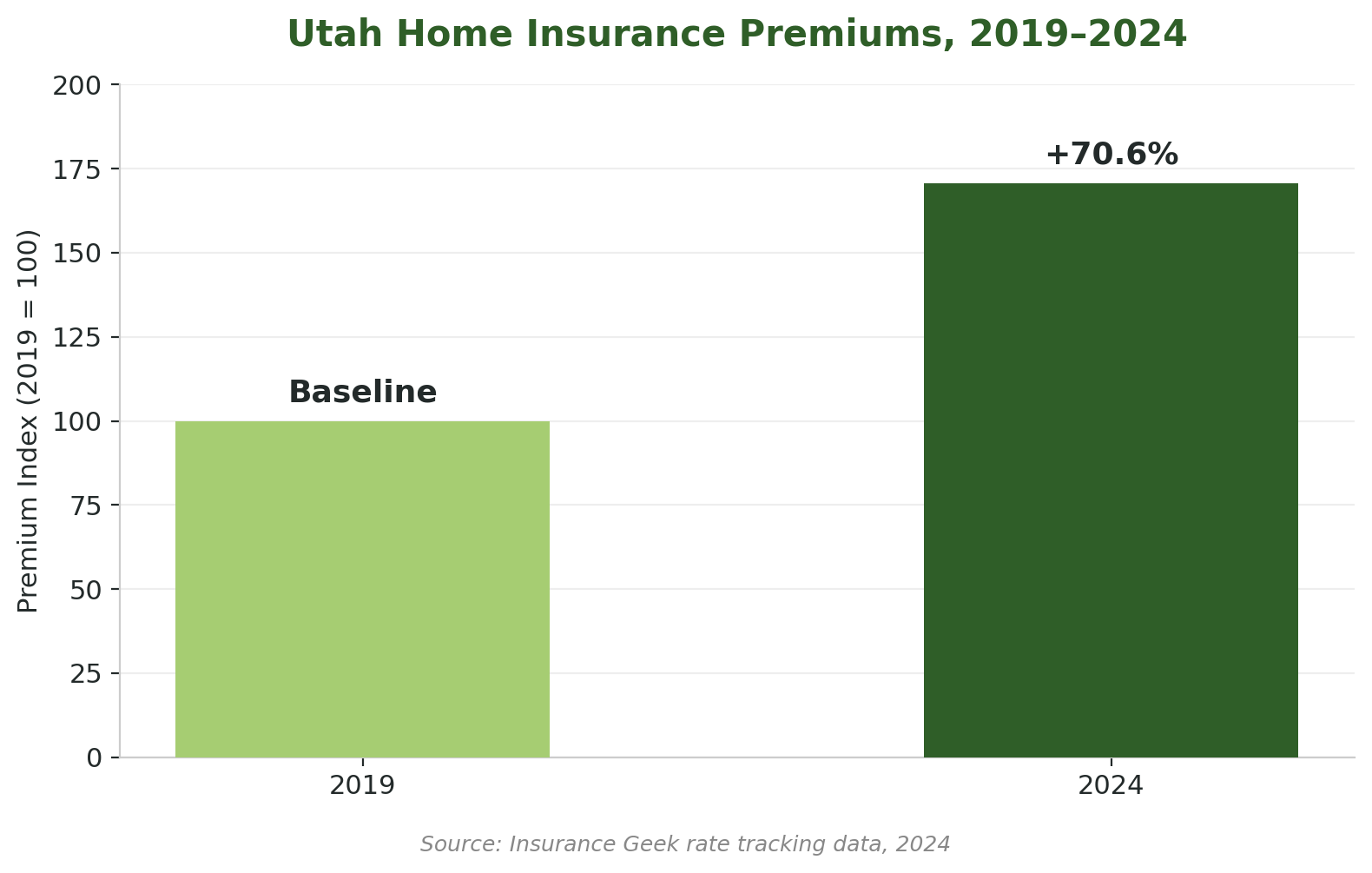
We've spent the last several years watching Utah homeowners and drivers absorb some of the steepest rate increases in the country. Utah home insurance premiums climbed a cumulative 70.6% between 2019 and 2024, according to Insurance Geek's rate tracking data, a jump second only to Colorado nationally. Auto rates followed a similar path as population growth along the Wasatch Front pushed traffic and claim frequency higher. So when industry analysts start talking about 2026 as the year things stabilize, it's worth asking what that actually means for the renewal sitting in your inbox right now.

This matters more than it sounds. A renewal increase of 8% feels manageable. A renewal increase of 30% on the same type of home, from a different carrier, means somebody left money on the table. The only way to know which one you're facing is to have someone actually compare the two.

Why Utah's Insurance Rates Climbed So Fast in the First Place

Utah's rate run wasn't random. A few things collided at once. Rebuilding costs for homes went up sharply after years of material and labor inflation. Wildfire risk maps got more aggressive, and insurers started pricing properties in the foothills and canyon communities accordingly. At the same time, more people moved to the Wasatch Front, which meant more cars on I-15 and more claims per capita.

The numbers back this up. Utah home insurance premiums rose a cumulative 70.6% from 2019 through 2024, the second-highest increase of any state behind Colorado, based on Insurance Geek's ongoing rate tracker. On the auto side, full coverage in Utah now averages around $2,565 a year, and credit score alone can shift a driver's monthly rate by roughly $155 between someone with excellent credit and someone with poor credit, according to recent industry rate analysis.

None of that is unique to one carrier. It's market-wide. That's exactly why shopping matters more now, not less.

The same pattern shows up on the auto side. Utah full coverage now averages roughly $2,565 a year, but recent 2026 rate comparisons from NerdWallet and Insurify show carriers like GEICO and Nationwide pricing full coverage for the same driver profile more than $1,000 below that average. Nobody tells you that when your renewal shows up. You only find out if someone actually checks.

What "Rates Are Stabilizing" Actually Means for Your 2026 Renewal

Industry surveys suggest more than 40% of agencies expect the hard market to ease across most lines of business in 2026. That's genuinely good news. But "the market is stabilizing" is an average, and averages hide a lot.

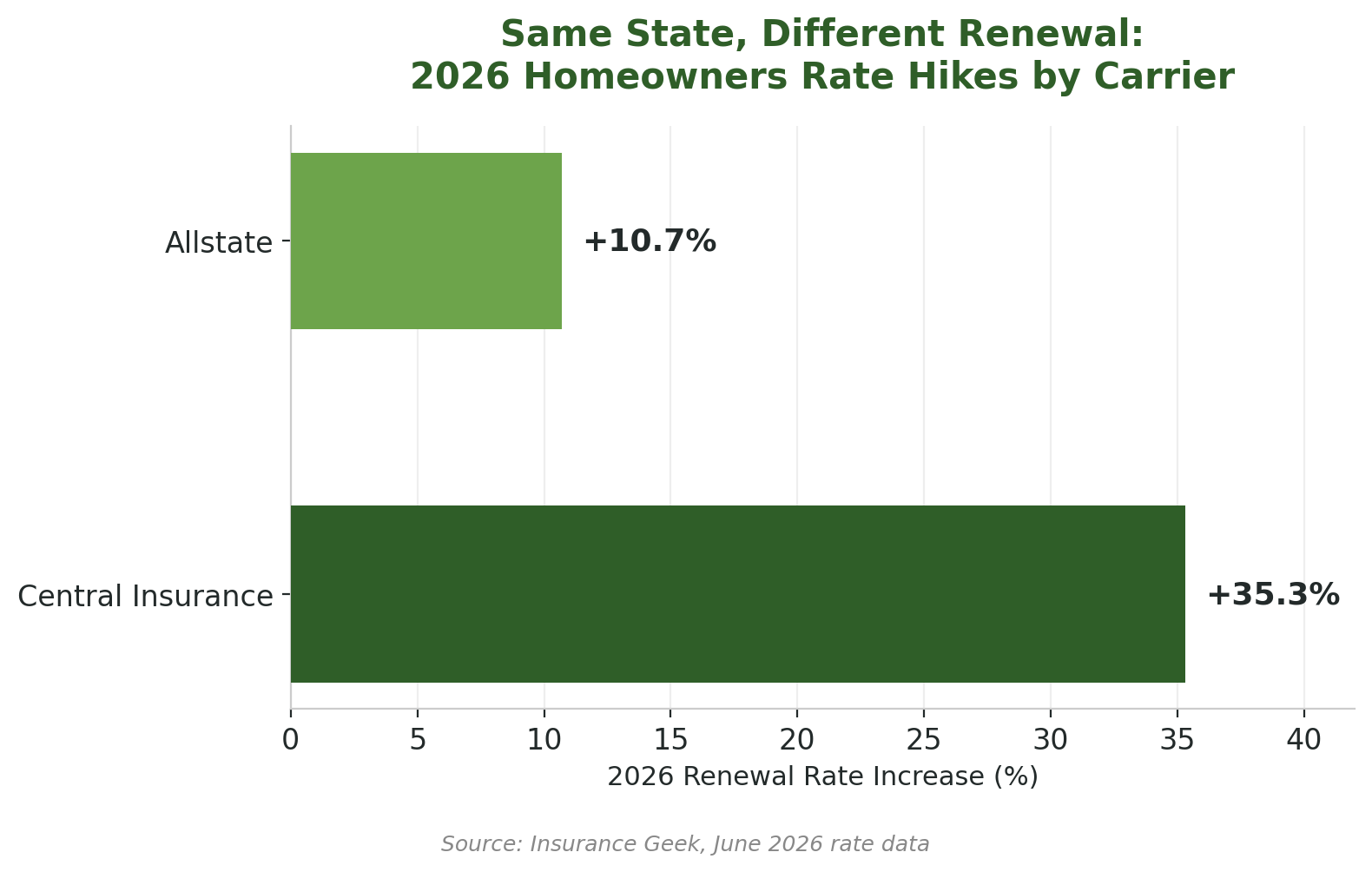
Look at what's actually happening carrier by carrier. In Utah's homeowners market this year, Openly rolled out more competitive new business pricing and capped renewal increases, while other carriers pushed rate hikes anywhere from 10.7% at Allstate to 35.3% at Central Insurance, according to Insurance Geek's June 2026 rate data. That's not a small spread. Two households with nearly identical homes could see wildly different renewal numbers depending purely on which carrier they happened to be with.

This is the part a single-carrier agent or a direct-to-consumer website can't help you with. If you're working with a captive agent, you get one company's rate, whatever it is this year. If you're comparing quotes yourself on a handful of comparison sites, you're mostly seeing marketing copy, not underwriting. An independent agent sees the actual spread across carriers and can tell you, plainly, whether your current renewal is competitive or whether it's time to move.


Chart comparing 2026 Utah homeowners insurance rate increases by carrier: Allstate at 10.7% versus Central Insurance at 35.3%
Chart showing Utah home insurance premiums rising 70.6% cumulative from 2019 to 2024

Why an Independent Insurance Agent in Utah Beats a Captive Agent or Comparison Site


Here's the practical difference. A captive agent, someone who works for State Farm, Allstate, or a similar single-carrier company, can only offer you that company's products. If their rates spike this year, that's the number you get. There's no alternative to shop internally.


An independent insurance agent in Utah works differently. At The Insurance Center, we work with 60-plus carriers, which means when one company has a bad underwriting year and prices up aggressively, we can place your coverage somewhere else instead of asking you to just accept the increase. We're also one of only six agencies in Utah with Big "I" Best Practices recognition, a credential that requires meeting professional standards most agencies aren't held to. That matters because it means knowing which carriers are financially stable, which ones handle claims well, and which ones are a bad fit for a given property or driving history.


Local knowledge counts here too. A national call center doesn't know that a property in Heber Valley might need different wind or snow load considerations than a similar home in Farr West. Our agents do, because we're actually here.


That local knowledge extends past homes and cars. A lot of our clients in Northern Utah also carry snowmobiles, ATVs, or boats, and those don't fit neatly into a generic online quote form. An agent who actually knows the area can tell you when a policy needs an endorsement for that equipment and when it doesn't, instead of leaving a gap you don't find out about until you're filing a claim.


A Real Example of How This Plays Out


Here's what this looked like for one Weber County client this spring. Their homeowners renewal came in with a 24% increase, driven mostly by updated wildfire risk mapping on their foothill property. Under Utah's House Bill 48, which took effect July 1, 2026, insurers now have to justify any increase over 20% if a policyholder requests it. Most people don't know that provision exists, let alone how to invoke it.


We did two things. First, we asked their current carrier to justify the increase under the new law. Second, and more importantly, we shopped the property against several other carriers who use different wildfire scoring models. The client ended up moving to a carrier with a materially better rate for the same coverage, without cutting anything from the policy. That second step, having someone who already knows which carriers price wildfire risk differently, is the part a homeowner shopping alone almost never gets access to.


We've seen a similar version of this play out on the auto side too, most often with families adding a new teen driver. A single carrier might price that addition aggressively because it doesn't want the added risk on its books. An independent agent can move just that vehicle, or the whole policy, to a carrier that prices new drivers more reasonably, without the family having to start their insurance search from scratch.


Frequently Asked Questions


Q: Is an independent insurance agent more expensive than buying insurance directly?

A: No. Carriers pay the agent's commission, so you typically pay the same premium as going direct, sometimes less since the agent can compare pricing across companies. Ask your agent to walk through this if you're unsure.


Q: What's the difference between an independent agent and a captive agent?

A: A captive agent, like one working exclusively for State Farm or Allstate, can only sell that company's products. An independent agent, like the team at The Insurance Center, represents multiple carriers and can place your coverage with whichever one fits your situation best.


Q: Will my insurance rates keep going up in Utah in 2026?

A: Probably somewhat, but less sharply than in recent years for most people. Individual carrier increases still range widely this year, from around 10% to over 35% depending on the company and property. Shopping your renewal is the only way to know where you land.


Q: Can an independent agent help if my homeowners renewal jumped more than 20%?

A: Yes. Under Utah's House Bill 48, effective July 1, 2026, insurers must justify rate increases over 20% if asked. An independent agent can request that justification and shop your policy against other carriers at the same time.


Q: How do I find out if The Insurance Center can get me a better rate?

A: Call us at (801) 622-2626. We'll compare your current policy against our network of 60-plus carriers at no cost and show you exactly where you stand.


The Bottom Line


A stabilizing market is good news, but it's an industry-wide average, not a promise about your specific renewal. The spread between carriers is still wide enough that shopping matters, maybe more than it did during the worst years of the hard market, because now there's actually room to find a better number instead of just bracing for another increase.


That's the case for working with an independent agent instead of a single carrier or a comparison website: someone needs to actually look at the spread across carriers and tell you honestly where you stand.


Ready to see whether your current renewal is actually competitive? Call The Insurance Center at (801) 622-2626, or visit us in Farr West or Heber Valley. We'll shop your policy across our carrier network and show you what's out there.


Coverage details and availability vary by policy, carrier, and state. This post is for educational purposes. Contact a licensed insurance agent at The Insurance Center for advice specific to your situation.

Contact The Insurance Center

1741 N 2000 W, Suite 5 Farr West Utah 84404, United States

A black, minimalist line icon of a telephone handset with a speech bubble above it.

Get A Quote

At The Insurance Center, securing your future is easy. Ready to protect what matters? Contact us for a quick quote and personalized insurance options!

A stylized icon of a person standing next to a shield containing a checkmark, representing security or protection.

Personal Insurance

From auto and homeowners to renters and umbrella policies, we help protect your family and property. Let’s find coverage that fits your life.

A black-line icon of city buildings with a dollar sign coin in front and a shield with a checkmark above.

Commercial Insurance

We customize policies for your industry's risks, like general liability and workers' comp, ensuring you can run your business worry-free.

Share this article

Recent Posts

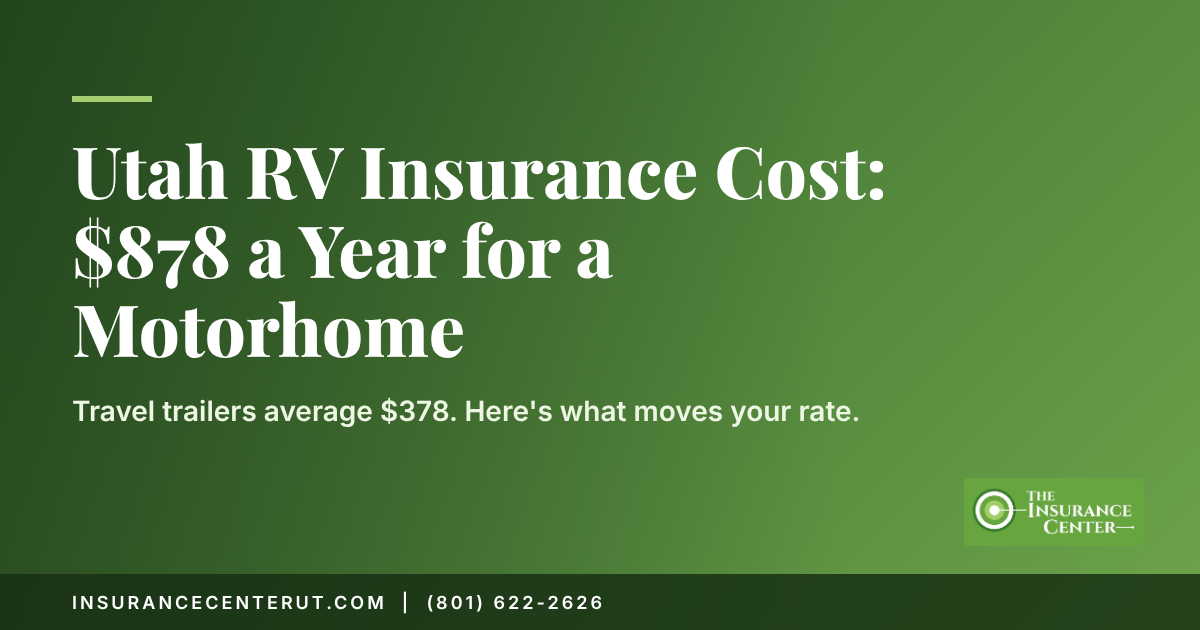
Utah RV insurance cost header: $878 a year for a motorhome, $378 for a travel trailer.
By Shawn Iverson • October 13, 2026
The average Utah motorhome policy costs $878.32 a year, and a travel trailer policy averages $377.56, according to Progressive's 2024 figures for 12-month Utah policies. That's about $73 a month for a motorhome and $31 a month for a trailer. If you're keeping a rig in a Heber Valley driveway or hauling a trailer up to Bear Lake every July, those averages are a starting point, not a quote. Roamly puts Utah motorhome coverage anywhere from $700 to $3,500 a year, and a travel trailer can run $200 or $1,000 depending on how it's insured. The short answer: what you drive, what it's worth, and which coverages you pick set the price. Here's how the numbers break down, what Utah law requires, and where owners get caught assuming they're covered when they aren't. What Does RV Insurance Cost in Utah? Utah RV owners pay between $200 and $3,500 a year, and the gap comes down mostly to motorhome versus towable. Here are the figures from the sources we checked: Utah motorhome average: $878.32 a year (Progressive, 2024 Utah 12-month policies) Utah travel trailer average: $377.56 a year (Progressive, 2024 Utah 12-month policies) Utah motorhome range: $700 to $3,500 a year (Roamly) Utah travel trailer range: $200 to $1,000 a year (Roamly) Liability-only motorhome policies: starting at $125 a year (Progressive) National range by class: Class A $600 to $2,500, Class B $480 to $1,000, Class C $540 to $1,500, towables $200 to $600 (HomeGuide) The class ranges come from HomeGuide's cost database, so use them to see how RV class changes the price, not as a Utah quote. One thing worth knowing about the Utah averages: Progressive's numbers reflect what Progressive charges its own Utah customers. They're real and they make a good anchor, but they aren't a market-wide survey. Roamly's $700 to $3,500 motorhome range shows how wide the spread gets once other carriers and other rigs enter the picture. That spread is the reason to compare quotes instead of accepting the first one. Is RV Insurance Required in Utah? Yes for motorhomes. Utah requires liability coverage on a motorized RV, and the minimums are $30,000 for injury to one person, $65,000 for injury to two or more people, and $25,000 for property damage in any one accident. Those limits come from Utah Code 31A-22-304 and apply to policies issued or renewed on or after January 1, 2025. That's up from the old 25/65/15 limits. Some RV insurance pages still list the old numbers, which applied to policies issued or renewed through December 31, 2024. State Farm's summary of the law says it covers private passenger autos, commercial vehicles and recreational vehicles. Ask your agent to confirm the limits on your current policy, especially if it renewed before 2025. Utah also lists personal injury protection as required, according to Progressive, and uninsured and underinsured motorist coverage can only be turned down by signing a rejection form. Travel trailers work differently. Liability on a towed trailer comes from the auto policy on the vehicle pulling it, and that coverage doesn't protect the trailer itself. If you financed the RV, your lender will usually require comprehensive and collision coverage too, according to HomeGuide. The Utah Insurance Department adds a reminder worth taking seriously: mandatory minimum coverage does not necessarily mean you have adequate coverage. Does Your Car or Homeowners Policy Cover Your Travel Trailer? Not reliably. The Utah Insurance Department says some auto or homeowners policies provide minimal coverage for a trailer, and it tells owners not to assume that coverage exists or that it's adequate. That one sentence hides the usual surprise. A trailer parked at a campsite, stored for the winter, or borrowed for a weekend may fall outside what your auto or homeowners policy was written to handle. Two questions settle it. Does your current policy pay to repair or replace the trailer itself? And what does it pay for the camping gear and contents inside? If either answer is "I'm not sure," that's the call to make before the first trip, not after the first claim. The same department says to read any rental contract before you sign it if you rent or borrow a trailer, and to confirm what coverage comes with it. What Moves a Utah RV Premium Up or Down? Five things do most of the work: the type and value of the RV, how the policy pays out, your deductible, how you use the rig, and your driving record. That list comes from HomeGuide's breakdown of RV rate factors, and it matches what we see when we quote. Type and value come first. A Class B camper van runs $480 to $1,000 a year nationally and a Class A motorhome runs $600 to $2,500, because the replacement cost and repair bills sit in different tiers. Newer, higher-value rigs raise premiums, and older ones can too because of mechanical risk. Payout structure matters more than most owners expect. Policies that pay depreciated value cost less than replacement-cost policies, and agreed-value policies are a third option. The cheaper premium means a smaller check after a total loss, so compare how each policy pays before you compare price. Deductible and use are the two levers you control. A higher deductible lowers the premium, and frequent long trips can raise it. A clean driving record, experience operating an RV and a low claims history all pull the rate down. Utah owners have one more variable: how the rig lives through winter, and whether anyone lives in it. Full-time and seasonal use change the policy itself, not just the price. Our Utah RV insurance guide for full-timers and seasonal owners covers that side in detail. How Can You Lower Your Utah RV Insurance Cost? The fastest ways to lower an RV premium are a higher deductible, a cleaner record and quotes from more than one carrier. Each one has a trade-off, so here's how they actually play out. Raise the deductible. HomeGuide lists this as a direct premium reducer, but the higher number comes out of your pocket on every claim, so pick one you could pay tomorrow without stress. Choose depreciated value only if you'd accept the payout. It prices lower than replacement cost, and it also pays out lower after a total loss. Protect your driving record. A clean record, experience operating an RV and a low claims history all lower rates. Consider liability-only on an older, paid-off motorhome. Progressive's liability-only policies start at $125 a year, which may fit a rig that isn't worth insuring for damage, as long as no lender requires more. Compare at least three quotes. The Utah ranges above show how far apart carriers and rigs can land. Skip the one move that looks like savings and isn't: cutting liability to the bare minimum on a large motorhome. The state minimum pays the other driver's costs up to $30,000 per person, and a serious accident can run past that fast. Ask your agent what limits fit your assets, not just the legal floor. Why Quote an RV Through an Independent Agent? An independent agent can price your RV with multiple carriers in one conversation, so you see more than one number. That's the whole advantage. Carriers like Progressive and Roamly publish useful rate data and are worth a look. But a quote from one company is one price from one underwriting model, and the Utah ranges above show how far apart those models can land. At The Insurance Center, we shop your RV across carriers, line it up against your auto and home coverage, and flag the gaps before they turn into a denied claim. Our RV insurance page explains how that works, and we write coverage for RV owners across Northern Utah, including Heber City and Park City . Frequently Asked Questions How much does RV insurance cost per month in Utah? A Utah motorhome averages about $73 a month ($878.32 a year) and a travel trailer averages about $31 a month ($377.56 a year), according to Progressive's 2024 figures for 12-month Utah policies. Your rate depends on the RV's class and value, your deductible and how you use it. Is RV insurance required in Utah? Yes for motorhomes. Utah requires liability coverage of at least $30,000 per person and $65,000 per accident for bodily injury, plus $25,000 for property damage, on policies issued or renewed on or after January 1, 2025 (Utah Code 31A-22-304). A towed travel trailer relies on the liability coverage of the vehicle pulling it. Does my car insurance cover my travel trailer in Utah? Not reliably. The Utah Insurance Department says some auto or homeowners policies provide minimal coverage for a trailer and warns owners not to assume it is adequate. Ask your agent whether your policy pays for damage to the trailer itself and for the contents inside. Is it cheaper to insure a travel trailer than a motorhome? Yes. Progressive's 2024 Utah averages put a travel trailer at $377.56 a year against $878.32 for a motorhome, so the trailer costs less than half as much. Roamly's Utah ranges show the same pattern: $200 to $1,000 for trailers and $700 to $3,500 for motorhomes. Can I buy liability-only RV insurance in Utah? Yes. Progressive says liability-only motorhome policies start at $125 a year. That meets the legal requirement but pays nothing toward damage to your own RV, and a lender will usually require comprehensive and collision coverage on a financed rig. The Bottom Line A Utah RV policy averages $878.32 a year for a motorhome and $377.56 for a travel trailer, but published ranges run from $200 to $3,500. The number that matters is yours. It depends on what you own, how the policy pays out, and whether your auto and home policies already do part of the job. Get those three things straight and the rest is just comparing quotes. Own an RV or shopping for one? Call The Insurance Center at (801) 622-2626 or get a free quote at InsuranceCenterUT.com. We'll price it across carriers and check what your auto and home policies already cover. Sources Progressive, Utah RV Insurance Roamly, RV Insurance in Utah HomeGuide, How Much Does RV Insurance Cost? Utah Code 31A-22-304 State Farm, Understanding Utah's New Auto Liability Coverage Law Utah Insurance Department, Outdoor Recreation & Insurance About the Author: Jett Iverson is the Director of Marketing at The Insurance Center, an independent insurance agency serving Northern Utah since 2001. He works alongside licensed agents to help Utah families and businesses understand their coverage options and make confident insurance decisions.
Utah disaster insurance header: what a homeowners policy leaves out, from flood to earthquake.
By Shawn Iverson • October 9, 2026
70% of Utah flooding hits outside hazard zones, and homeowners policies skip flood, quake and mudslide. Get the fixes. Call (801) 622-2626.
Key person and buy-sell insurance header: $1M of coverage costs about $100 a month
By Shawn Iverson • September 25, 2026
A $1M key person or buy-sell policy on a healthy 40-year-old owner runs about $86-$109/month. See which buy-sell structure fits. Call (801) 622-2626.