Utah ATV insurance costs about $88 a year for liability and $327 for full coverage. See UTV costs and what Utah requires. Call (801) 622-2626.

Utah's benchmark health plan costs $716 a month in 2027, up $76. See prices by tier and what you'd pay after subsidies. (801) 622-2626
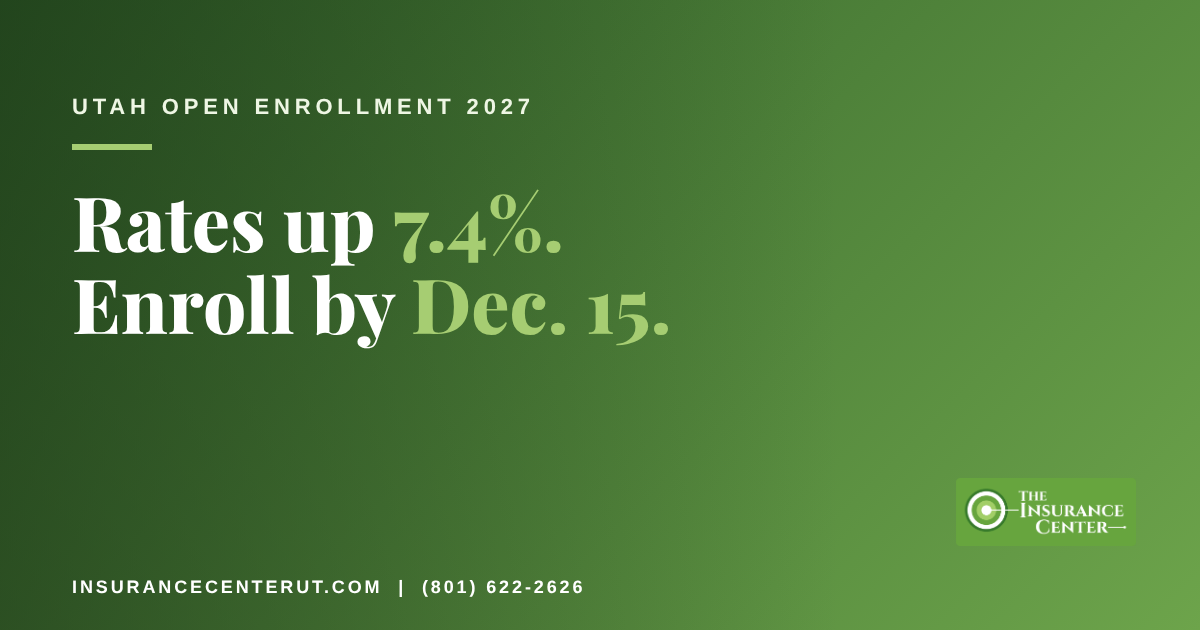
If you buy your own health insurance in Utah, you have until Dec. 15 to lock in coverage that starts Jan. 1, and the average premium is rising 7.4% before subsidies. That's according to ACASignups.net's review of the Utah Insurance Department's final 2027 rate filings, and it's only an average: carriers filed average increases anywhere from 3.9% to 15.8%. Here's the short version of Utah health insurance open enrollment 2027. The window runs Nov. 1 through Jan. 15, the Dec. 15 cutoff is the one that keeps you from going uninsured in January, and the number that decides your actual bill is where your income lands against the subsidy limit, not the headline rate hike. Maybe you're self-employed in Weber County. Maybe you're a Heber Valley family that lost employer coverage, or you've let your plan auto-renew for three years without opening the paperwork. Each of you is facing the same calendar and the same rule changes, so here's what's different this year and what to check before you click anything. When Is Utah Open Enrollment for 2027 Health Insurance? Utah open enrollment for 2027 coverage runs Nov. 1, 2026 through Jan. 15, 2027, and you have to enroll by Dec. 15 for coverage to start Jan. 1, according to HealthCare.gov . Utah uses the federal marketplace rather than a state-run exchange, so those are the dates that apply here. Nov. 1, 2026: open enrollment begins Dec. 15, 2026: last day to enroll for coverage starting Jan. 1, 2027 Dec. 16, 2026 to Jan. 15, 2027: you can still enroll, but coverage starts Feb. 1 Jan. 15, 2027: open enrollment ends That Dec. 16 to Jan. 15 stretch is where people get burned. If your current plan ends Dec. 31 and you sign up on Dec. 20, you're uninsured for all of January. Treat Dec. 15 as the real deadline. How Much Are Utah Health Insurance Rates Rising in 2027? Utah's individual market rates rise 7.4% on average for 2027 before subsidies, per ACASignups.net's analysis of the final filings in the Utah Insurance Department's rate database. Preliminary filings had the average at 6.7%. Utah is getting off easier than the country: the national weighted average approved increase is about 14% before subsidies, per HealthInsurance.org's 2027 rate roundup , and Utah's own average increase for 2026 was 14.2%, per its Utah marketplace guide . Where your plan lands depends on the carrier. Preliminary filings, as compiled by ACASignups.net , show: Regence BlueCross BlueShield of Utah: 3.9% average increase SelectHealth: 6.0% average increase, ranging from 4.3% to 15.7% by plan BridgeSpan: 7.5% average increase Imperial Health Plan of the Southwest: 15.8% weighted average increase, ranging from 9.9% to 21.3% by plan University of Utah Health Insurance Plans: double-digit increases, with plan-level changes starting at 10.9% A lower percentage doesn't mean a lower bill. A plan that rises 3.9% from a high starting price can still cost more than one that rises 8% from a cheaper base. For illustration, a 6% increase on a $600 monthly premium adds $36 a month, and 15.8% adds about $95. Compare the 2027 dollar amounts side by side, not the percentages. Do You Still Qualify for Premium Tax Credits in Utah? You qualify for premium tax credits if your household income is at or below 400% of the federal poverty level, which for 2027 coverage is $63,840 for a single person and $132,000 for a family of four, per HealthInsurance.org . The expanded credits that removed that income ceiling expired at the end of 2025, so the cliff is back. Cross the line and the credit disappears entirely. It doesn't taper. The credit still matters a lot in Utah. In 2026, 387,336 Utahns enrolled in private marketplace plans, nearly 90% qualified for a premium tax credit, and the average credit was $499 a month, which brought the average net premium down to $68 a month, according to CMS data summarized by HealthInsurance.org. Nationally, average net premiums rose 58% in 2026 once the expanded credits expired. Income estimates are where self-employed Utahns trip up. The credit is based on the income you project when you apply, and if your actual income lands differently, you can owe money back or get a bigger credit at tax time. For a single filer, projected incomes of $63,000 and $64,500 sit on opposite sides of the $63,840 line. If you're close, talk with your CPA about what counts as income before you finalize the application. What Happens If You Do Nothing During Open Enrollment? If you do nothing, last year's enrollees are generally re-enrolled automatically, but the plan you land in may cost more, change its network, or no longer exist. Carriers have been pulling out of marketplaces around the country for 2027, as Intuit TurboTax noted in an October 2026 guide distributed by Stacker . Auto-renewal also carries forward the income and household information you gave last year. If your income changed, you got married, or a kid aged off your plan, your credit gets calculated on the wrong numbers. Log in, update the application, and look at the 2027 plan list even if you plan to stay put. How Do You Compare Utah Health Plans Without Overpaying? Start with your doctors and prescriptions, not the premium. A cheap plan that drops your specialist or doesn't cover your medication costs more than an expensive one that does. Here's the checklist we walk clients through: Confirm your doctors and hospital are in the 2027 network. Last year's network doesn't count. Check each prescription against the plan's drug list, called a formulary. Compare total cost: the premium plus the deductible and the out-of-pocket maximum. If your household income is at or below 250% of the poverty level, look at Silver plans first. They carry cost-sharing reductions that lower your deductible and copays, and about 44% of Utah's 2026 enrollees picked a Silver plan. Check whether you're eligible for Medicaid or CHIP at medicaid.utah.gov before you buy. If you are, you can't get marketplace credits. Does Using an Independent Agent Cost More Than HealthCare.gov? No. Marketplace premiums are the same whether you enroll through HealthCare.gov or through an agent, and the carrier pays the agent's commission, not you. HealthCare.gov works fine if you already know your plan and your income is simple. An agent earns the time when you're keeping a specific doctor, your income is hard to predict, or something changed this year. At The Insurance Center , we're independent, so we compare plans across carriers instead of selling one company's product. A licensed Utah health insurance agent on our team will check your doctors and prescriptions against the plans, estimate your credit, and walk you through the enrollment step by step. We work with clients from our Farr West and Heber City offices, and by phone anywhere in Utah. Frequently Asked Questions What is the last day to enroll in Utah health insurance for coverage starting January 1, 2027? The last day is Dec. 15, 2026. Enrollments completed from Dec. 16 through Jan. 15, 2027 start Feb. 1. Dates can change, so confirm them at HealthCare.gov before you act. How much will Utah health insurance cost in 2027? Utah individual market premiums rise 7.4% on average for 2027 before subsidies, per ACASignups.net. What you pay depends on your income, your age, and the plan. In 2026, the average Utah marketplace enrollee paid $68 a month after subsidies, according to CMS data summarized by HealthInsurance.org. Is there still a subsidy cutoff for Utah health insurance in 2027? Yes. Premium tax credits stop at 400% of the federal poverty level, which is $63,840 for a single person and $132,000 for a family of four for 2027 coverage. The expanded credits that removed the cutoff expired at the end of 2025. Can you get health insurance in Utah outside of open enrollment? Yes, but only with a qualifying life event such as marriage, a new baby, a move, or losing other coverage. American Indians and Alaska Natives can enroll at any time, and Medicaid and CHIP applications are accepted year-round. Is Medicare open enrollment the same as ACA open enrollment? No. Medicare has its own Annual Enrollment Period, which runs Oct. 15 to Dec. 7, and it's a separate system from the ACA marketplace. The Insurance Center helps with Medicare as well, so call us if you're turning 65 or reviewing a Medicare plan. The Bottom Line on Utah Health Insurance Open Enrollment 2027 Mark Dec. 15 on your calendar, check your projected income against the $63,840 and $132,000 lines, and don't let auto-renewal pick your plan for you. A 7.4% average increase is manageable for most subsidized households, but the carrier you're on and the income you report can move your bill much further than that. Ready to review your 2027 health coverage? Call The Insurance Center at (801) 622-2626 or get a free health insurance quote at theinsurancecenter.com . You can also stop by our Farr West or Heber City office. Rates and dates reflect sources current as of November 2026. Confirm deadlines at HealthCare.gov, and ask your agent how these numbers apply to your situation. About the Author: Jett Iverson is the Director of Marketing at The Insurance Center, an independent insurance agency serving Northern Utah since 1995. He works alongside licensed agents to help Utah families and businesses understand their coverage options and make confident insurance decisions. Sources HealthCare.gov, Dates and deadlines HealthInsurance.org, Utah Health Insurance Marketplace: 2027 ACA Coverage Guide (updated Oct. 30, 2026) HealthInsurance.org, Health insurance premium increases for 2027 ACASignups.net, 2027 Rate Changes: Utah (updated Sept. 17, 2026) Utah Insurance Department, Health Insurance Rate Transparency Database Intuit TurboTax via Stacker, 10 things to know about open enrollment for 2027